
Recycling of the aluminium closure at its end-of-life stage

For recycling of the aluminium closure at its end of life, credits are given for the consequent avoidance of producing primary material. Recycling of aluminium needs about 95% less energy compared with its primary production, with the corresponding significant reduction in the climate change impact.
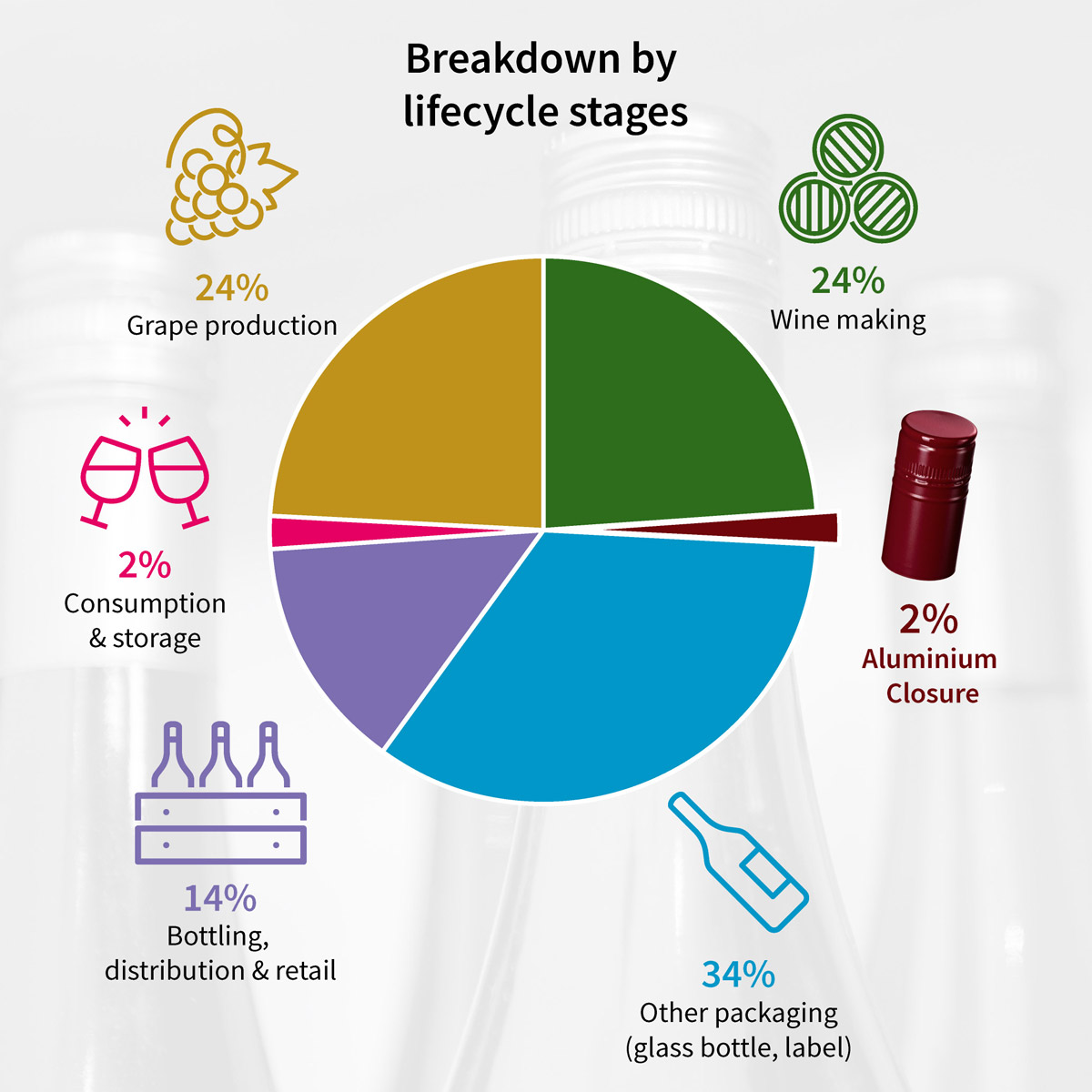
According to the PEFCR for wine, the current recycling performance for aluminium in Europe is 69%. With this recycling rate, a significant reduction of the aluminium closure’s environmental footprint is already being achieved. Increasing the recycling rate to 100% leads to a further reduction of the aluminium closure’s climate change impact by 18% and to a climate change reduction of the whole bottle of wine (0,75 L) by 0,4%.
It is important to point out that aluminium closures can easily be sorted and recycled, whether collected with glass or together with other light aluminium packaging.
Weight reduction of the aluminium closure

Reducing the amount of aluminium used in the closure can further mitigate the closure’s climate change impact: Cutting the aluminium content of the closure by 15% (from 4,2g to 3,6g) leads to a reduction of its climate change impact by 14%, and to a climate change reduction of the whole bottle (0,75 L) by 0,3%. This demonstrates how even small material optimisations can contribute to more resource-efficient packaging solutions and support overall sustainability goals within the packaging industry.
Wine loss reduction

Wine loss at the consumer stage has a relevant influence on the overall climate change impact of a wine’s life cycle. The LCA considered an average wine loss rate of 5%, in line with the PEFCR for wine, irrespective of the type of closure. This potential wine loss can be assessed as relevant when taking into consideration the global trade volume of bottled wine.
Aluminium closures can potentially decrease the wine loss rate at consumer level to below 2%. Thus, aluminium closures can help to reduce the climate change impact of a bottle of wine by at least 3% - this is more than the impact of the closure itself.
Sources & additional information
This document is based on the Screening LCA of aluminium closures by Quantis (2021) based on PEF. Quantis is an environmental sustainability consultancy with a strong focus on scientific integrity. They are part of several sector-specific collaborations in order to share insights and develop common standardized approaches to tackle climate related challenges.
You can download our Explanatory Note and the Infographic.